
What Actually Makes a Leadership Role Hard to Fill?
Why "hard to fill" often means the brief, not the market. On self-created candidate shortages in senior leadership search.
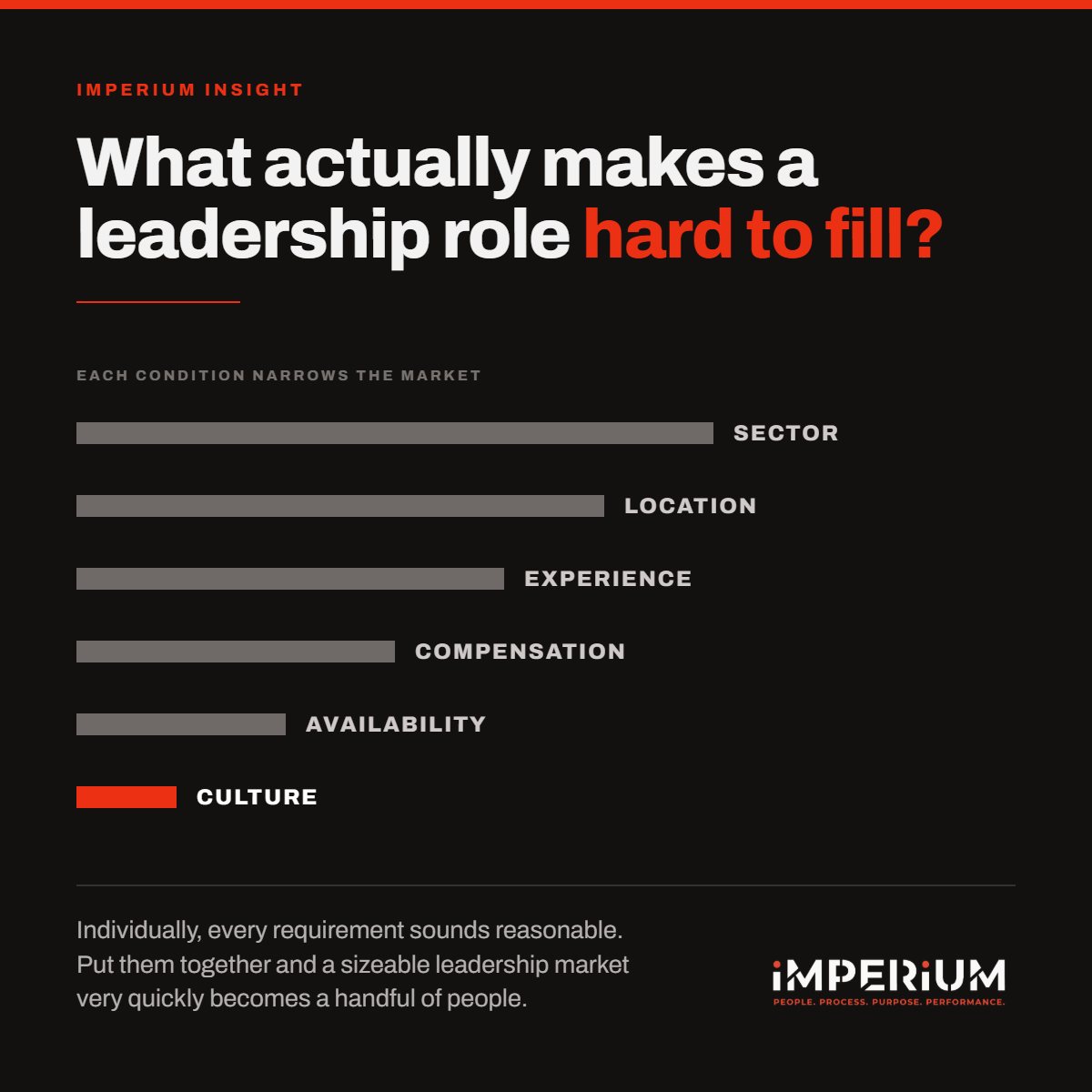
What Actually Makes a Leadership Role Hard to Fill?
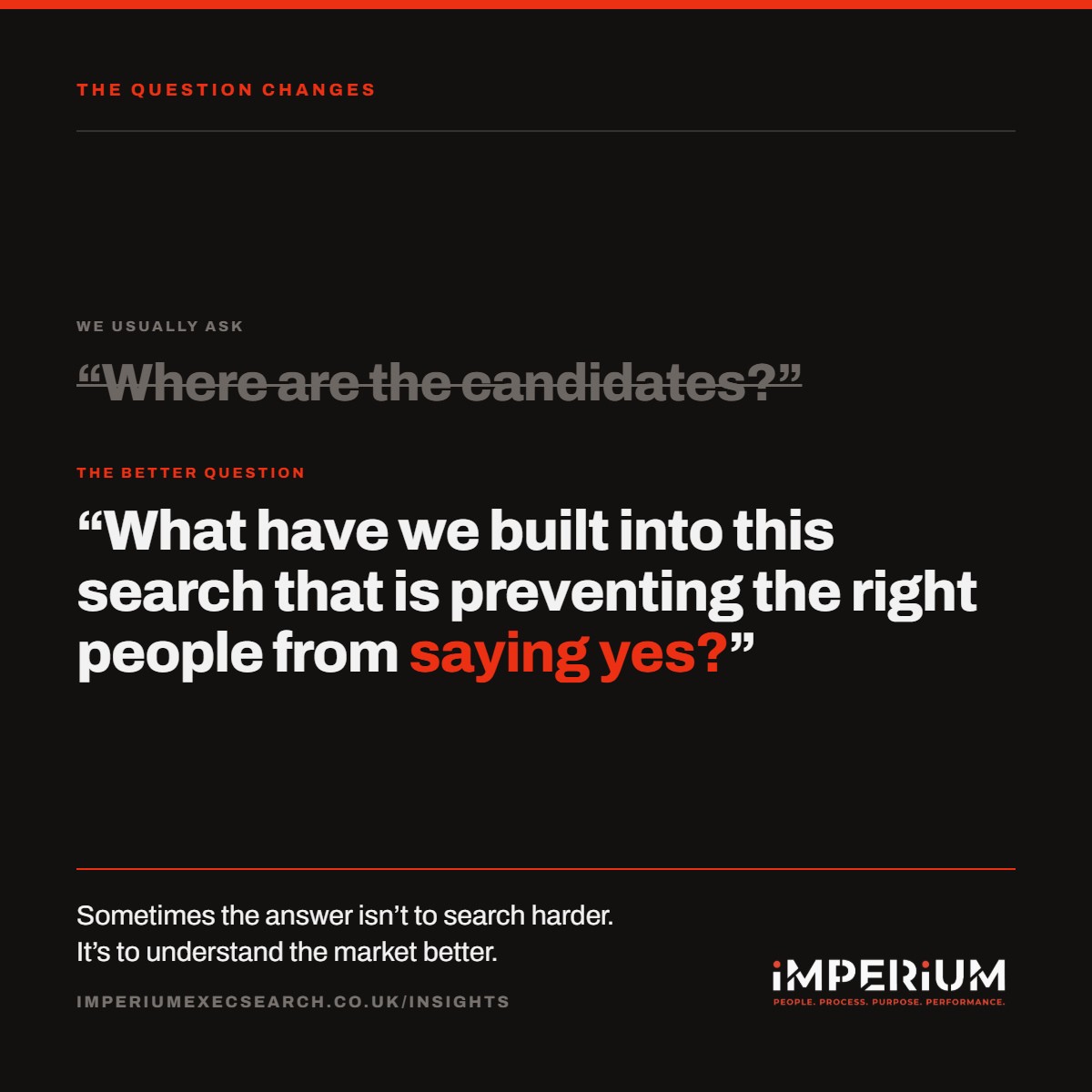
Sometimes the answer isn't to search harder. It's to understand the market better.
A client wants a unicorn. Chartered, sector-specific, already at this exact title, same scale, same geography, available inside six weeks, priced like a horse.
Nobody puts it that way. The brief reads as a list of sensible requirements. But a unicorn is also a list of sensible requirements — a horn, wings, hooves, a coat nobody's seen before — and no single feature is the problem. The problem is that no one creature has ever carried all of them at once.
A leadership role gets described as "hard to fill" often enough that the phrase has stopped meaning anything specific. Sometimes it's accurate: there is a genuine shortage of people with the required skills and experience, and the search reflects a real gap in the market. Sometimes it isn't. The candidates exist. The difficulty has been built into the search itself.
The brief that narrows the market
An organisation defines the ideal leader with precision. Someone who:
- comes from a direct competitor
- has already held the same position
- knows the same market
- lives within a particular geography
- has operated at precisely the same scale
- accepts the compensation being offered
- can move within the required timescale
Individually, every one of those conditions sounds reasonable. A hiring committee could defend each line on its own.
Put them together and a sizeable leadership market becomes a handful of people. Add reputation, confidentiality, notice periods and a lengthy interview process, and the handful gets smaller still. Stack enough reasonable conditions on top of each other and you've stopped briefing for a leader. You've briefed for a unicorn — a creature built entirely out of features that have never occurred together in the same animal.
At that point the question stops being "where are the candidates?" It becomes: what have we built into this search that is preventing the right people from saying yes?
The unicorn, taken apart
On a recent global leadership search, the original brief asked for one thing above the rest: direct, hands-on experience in the client's own product category, at global P&L scale.
That combination barely exists. Executives running P&Ls of that size, in that specific category, at that level of seniority, number in the low single figures worldwide — and most of them are not moving.
Widened to executives with comparable P&L scale and channel complexity in adjacent industrial sectors — proven at the same altitude, missing only the exact product label — the market opened. Nine credible candidates came forward. Several scored above 90% against every other criterion in the brief: revenue growth, organisational build, channel leadership, cross-cultural influence, financial acumen. The one line they didn't tick was the one line the original brief had insisted on above all the others.
The category-specific horn was never the leader. It was one feature, on one gate, in a much longer list of things that mattered.
Two different problems, two different answers
A genuine shortage and a self-created one look identical from the outside. Both produce the same symptom: a role that has been open too long, a shortlist that keeps collapsing, a client asking why nobody suitable has come forward.
They require different responses. A genuine shortage is a market problem — the answer is patience, a wider net, or a rethink of what "equivalent experience" means. A self-created shortage is a design problem — the answer is going back through the brief and asking which conditions are load bearing and which are just comfortable.
Confusing the two wastes time in both directions. Search harder against a genuine shortage and the market doesn't move any faster for the effort. Accept a self-created shortage as a market fact and a business quietly narrows its own options, appointment after appointment, without ever deciding to.
The question worth asking first
Before a search begins, the more useful question isn't "how do we find the right person?" It's "what have we specified that only the right person could satisfy — and is any of it actually necessary?"
You're rarely short of leaders. You're insisting on the horn.
Understanding the market beats searching harder. It just requires asking the harder question first.
Ikram Rabbani is Founder and Executive Managing Director of Imperium Executive Search, a retained search firm specialising in senior and board-level appointments across engineering, infrastructure, construction and the built environment.
Sector Tags