
Roti. Kapra. Makaan.
In Urdu there are three words for everything a person needs. Food, clothing, shelter. What a person needs to survive and what a nation needs to function are not two different things. One is simply the other at scale.
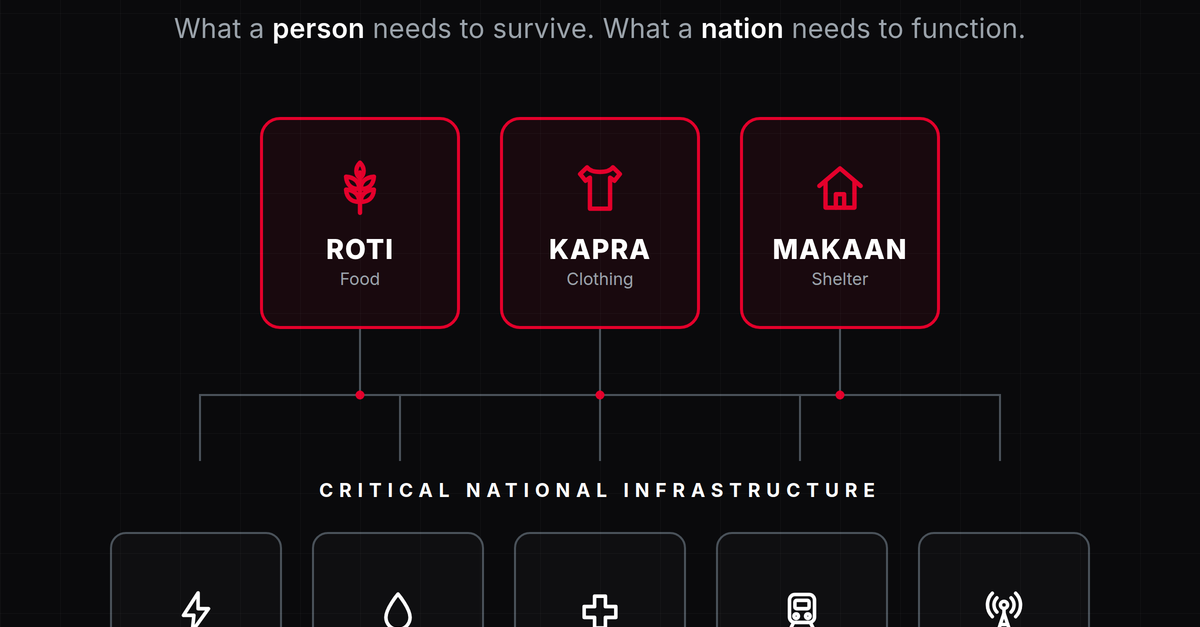
Roti. Kapra. Makaan.
In Urdu there are three words for everything a person needs.
Roti. Kapra. Makaan.
Food, clothing, shelter. I grew up with them. Most families with roots in South Asia can recite them like a proverb, because that's what they are.
Recently I came across a diagram of the UK's Critical National Infrastructure. Energy. Water. Health. Transport. Communications. The systems a nation cannot function without.
The official list runs to thirteen sectors, and food — roti — is on it. Clothing and housing are not. Make of that what you will, in the middle of a housing crisis.
But look closer and the two lists are the same list.
Roti doesn't reach a plate without water, energy and transport. Kapra doesn't reach a shop without manufacturing, ports and logistics. Makaan doesn't stand without construction, materials and the grid.
What a person needs to survive and what a nation needs to function are not two different things. One is simply the other at scale.
Thirty years of recruiting into these sectors has taught me one more thing. We call the systems critical. We are slower to say it about the people who run them. A treatment works, a substation, a rail programme — each one is, in the end, a group of people making decisions under pressure.
If the infrastructure is critical, so is its leadership.
That's the list I work from.
Ikram Rabbani is Founder and Executive Managing Director of Imperium Executive Search, a retained search firm specialising in senior and board-level appointments across engineering, infrastructure, construction and the built environment.
Sector Tags