The Number Went Down. The Problem Didn''t.
Construction has slowed. The leadership shortage hasn''t gone away. A quieter market is masking a bigger problem: engineering and construction will need more experienced leaders just as many of its most experienced people begin to leave.
The Number Went Down. The Problem Didn't.
Construction has slowed. The leadership shortage hasn't gone away.
A quieter market is masking a bigger problem: engineering and construction will need more experienced leaders just as many of its most experienced people begin to leave.
Across main contracting, engineering, project management, programme management and portfolio management, the same structural issue keeps appearing: the longer-term pipeline of work will require a depth of experienced people the industry is struggling to produce and retain. That would be difficult enough on its own. It becomes considerably more serious when a significant proportion of the people carrying the industry's experience are approaching the later stages of their careers.
The current slowdown can disguise that problem.
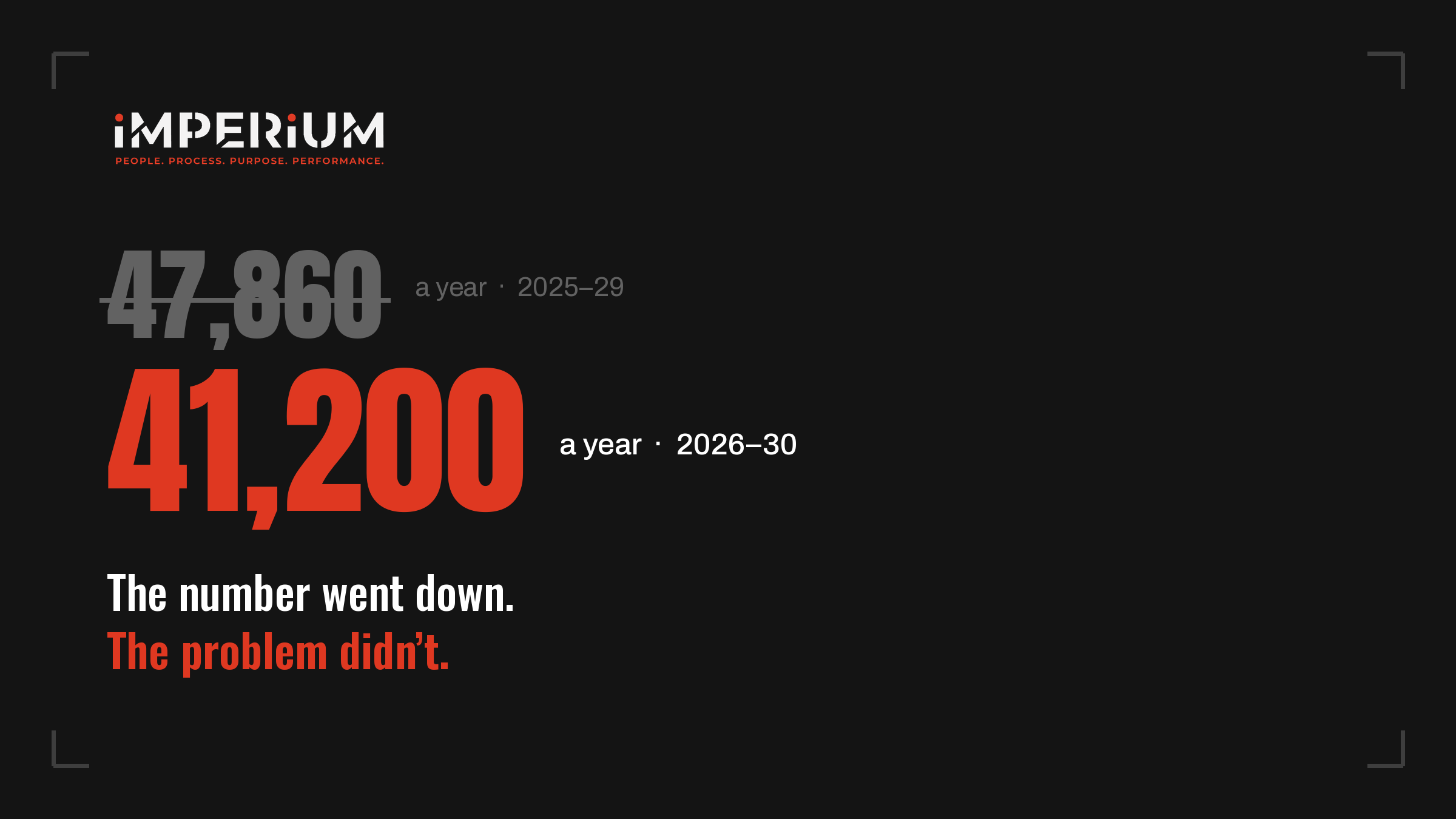
In June, CITB lowered the number of additional workers construction is forecast to need. Its Construction Workforce Outlook 2026–2030 puts the requirement at an average of 41,200 additional workers a year to 2030, around 206,000 across the five years. The previous edition, covering 2025 to 2029, asked for 47,860 a year.
So the headline number has fallen by around 14%, and I have already seen it quoted as evidence that the pressure is easing.
It isn't. The lower requirement partly reflects a weaker near-term output forecast. It does not mean the underlying workforce problem has disappeared. CITB expects UK construction output to contract by 0.2% this year before recovering to 1.8% in 2027 and 2.8% in 2028, with infrastructure one of the strongest parts of the picture at around 2.5% growth a year across the period. The five-year requirement is lower partly because the assumptions at the front end of the forecast are weaker. Nothing in that revision tells us that experienced people will be easier to find when output accelerates in 2027 and 2028.
That is the trap boards keep walking into. Workforce pressure looks manageable while recruitment is subdued and becomes expensive when activity returns and everyone is competing for the same people.
CITB itself is blunt about the underlying position: too few people are entering the sector, too many experienced workers are leaving, and productivity has not improved sufficiently to close the gap. Its Industry Picture 2026 warns that this will increasingly strain the industry's capacity to deliver on housing, infrastructure and retrofit commitments.
The Risk Hidden Inside the Headline Number
Headcount is the easy part to model. Experience is harder.
The Construction Industry Council says the age profile of the UK-born construction workforce peaks between 50 and 64. The Council's assessment is that this could mean the loss of more than 500,000 UK-born workers — around a quarter of the workforce — over the next 10 to 15 years.
Engineering is not insulated from this. EngineeringUK's April 2026 workforce update counts approximately 6.3 million people working in engineering and technology roles, around 19% of UK jobs. Separately, the IET's latest skills research found that 76% of engineering employers struggle to find certain skills when recruiting. The problem is not purely technical either: 24% identified leadership and management skills among those that are difficult to find.
Rising long-term demand, a constrained supply of new entrants, and an ageing group of people holding much of the industry's accumulated knowledge and experience. That is the position we are in, whatever this year's output figure says.
Directors Are Accumulated, Not Recruited
The pressure is not confined to site delivery. It runs through main contracting, engineering, project management, programme management and portfolio leadership. The more complex the role becomes, the smaller the pool of people who have already carried that level of accountability.
I place senior people for a living, and this is the part clients underestimate most consistently.
A commercial director who has been through three downturns prices risk differently from one who has been through none. Not because they are cleverer, but because they have watched a subcontractor fail mid-programme and they know what the first warning sign looked like. An engineering director identifies a delivery problem eight weeks early because the sequence matches something they have seen go wrong before.
You cannot buy that on demand, because everyone else wants it in the same quarter. And you cannot train it in eighteen months.
A strong project manager does not become a programme director by promotion. Moving from running a job to running a portfolio — with directors reporting to you and a client board asking questions a programme cannot answer — is a different discipline. Some make that step. Others are excellent in the role they already hold and can be set up to fail by being promoted into a fundamentally different one. Working out which is which takes years of exposure and someone senior deliberately building them.
A regional contractor lost a senior operational director on 12 weeks' notice with no internal successor ready. The business moved straight away. Its talent acquisition team opened the search in the first week, alongside several other high-priority requisitions already in the queue. At the next monthly board meeting the executive team approved bringing in a specialist — which is where I came in, six weeks after the resignation.
In the meantime, the managing director, commercial director and two project leads carried the role between them, on top of workloads that were already full. Decisions took longer to reach. A key client relationship needed managing at board level. A major tender went out without the operational input that role would normally have provided.
The search took eight weeks. By the time the offer was accepted the outgoing director had been gone a fortnight, and the successful candidate then had 12 weeks' notice of their own to serve. The package came in above budget. From resignation to replacement starting, 26 weeks passed: six months, 14 of them with nobody permanently in the role.
None of that was a recruitment failure. Once the search was properly resourced it ran at a normal pace, and it gave the business a clear read on its own market: who was out there, what they cost and where they sat. That intelligence would have been worth considerably more six months earlier, when it could have shaped a plan rather than confirmed a problem. What recruitment could not do was recover the weeks already spent or shorten the notice periods at either end. The only thing that would have done that was a successor identified before there was a vacancy.
What AI Changes, and What It Doesn't
Every conversation about workforce capacity now arrives with AI attached, so it is worth being clear about where I think it lands.
AI is already doing real work in this sector. It reads documents faster than a team of people, finds patterns in programme data, drafts reporting, and lifts a significant administrative load off senior staff. Anyone dismissing it is not paying attention.
What AI changes is the capacity and productivity of the people you already employ. What it does not do is create another experienced project director, commercial director or engineering director. It can amplify judgement; it cannot manufacture decades of it. When a £500 million programme starts slipping and the client is in the room, somebody has to hold a position, carry the accountability and make a call on incomplete information with a relationship at stake. AI does not remove that accountability from the board, or from the executive carrying it.
I have watched businesses postpone succession planning for far weaker reasons than AI. It has rarely turned out to be the cheaper option.
Four Questions Worth Putting to a Board
They take about an hour to work through properly. In my experience the answers expose more risk than the leadership team expected to find.
Which individuals hold knowledge or relationships we could not replace inside six months? Most businesses can name them straight away, which tells you how concentrated the risk already is.
Who succeeds each of them, and is that person ready or simply identified? There is a large difference between a name in a box on a slide and somebody who could hold the role in April.
How does our internal successor compare with what the external market actually holds? Without an external benchmark, a board knows who its strongest internal candidate is. It does not necessarily know how that person compares with the strongest people available in the market.
Where could advisory, mentoring or fractional roles help us retain critical experience? Not every senior person needs to be retained in a conventional full-time executive position. Advisory, mentoring and consultancy arrangements can preserve access to experience while the next generation develops underneath them.
Succession Planning Does Not Begin with a Resignation
If a critical director resigns on Monday and the conversation about their successor starts on Tuesday, you are recruiting under pressure and paying handsomely for the privilege. It may still be good recruitment. It is a long way from succession planning.
The work happens years earlier: identifying the roles the business cannot run without, testing whether internal candidates are real or notional, developing the ones who are real, and understanding what sits in the external market before anyone needs it.
The last decade rewarded companies that could win the work. The next one will reward companies that can staff it. Output forecasts move every six months. The demographics do not. When activity accelerates again, the businesses competing for the same small pool of experienced directors will be those that waited for the work to arrive before asking who would lead it.
Imperium Executive Search Limited works with organisations across construction, infrastructure, engineering, energy, utilities and transportation to secure senior leadership. Our research-led approach also supports confidential talent mapping, external benchmarking and succession planning before a leadership gap becomes an urgent search.
People. Process. Purpose. Performance.
Sources: CITB, Construction Workforce Outlook 2026–2030; CITB, Construction Workforce Outlook 2025–2029; CITB, Industry Picture 2026; Construction Industry Council, age profile of the UK-born construction workforce; EngineeringUK, The Engineering and Technology Workforce, April 2026; IET, UK Engineering and Technology Skills.
Ikram Rabbani is Founder and Executive Managing Director of Imperium Executive Search, a retained search firm specialising in senior and board-level appointments across engineering, infrastructure, construction and the built environment.
Sector Tags